

Artificial intelligence has become a catch-all term for almost anything that processes data, spots patterns, or automates decisions. In quantitative finance, that can be misleading. A model can be sophisticated and still be useless. A backtest can look impressive and still be wrong.
So the real question is not whether AI belongs in quantitative research. It already does. The better question is where that extra complexity actually helps — and where simpler statistical methods are still the better tool.
AI is most useful when it lets researchers measure more, model more, or test ideas more efficiently. But it does not remove the need for a good research question, reliable data, careful validation, and human judgment. In markets, those surrounding disciplines often matter just as much as the model itself.
Before the Model Comes the Question
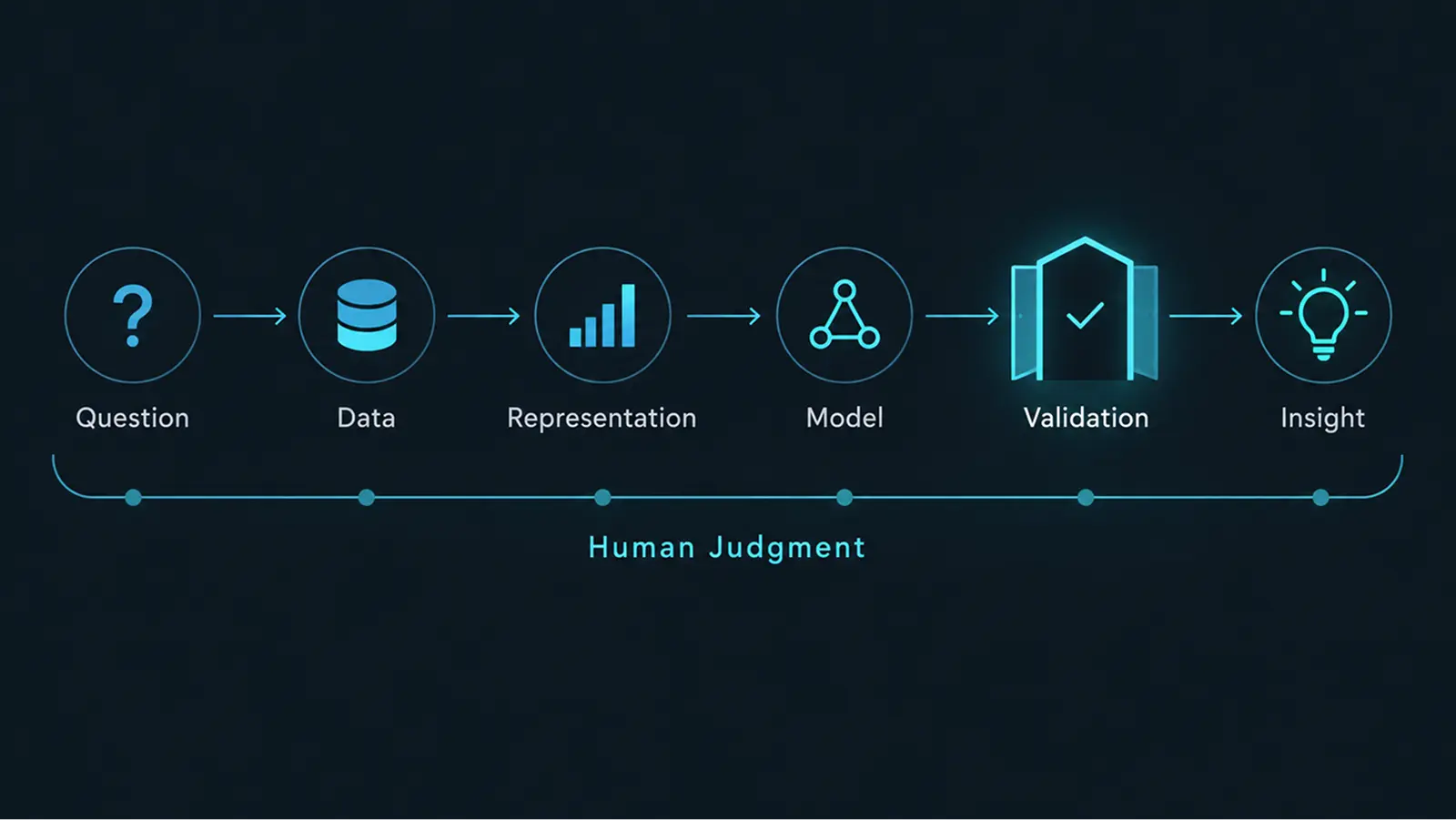
Quantitative research is sometimes described as if you feed data into a model and a trading decision comes out the other side. Real research is much less automatic than that.
Before choosing a model, a researcher has to decide what to measure, why it might matter, what evidence would support or weaken the idea, and over what time horizon the relationship should be tested. They also need to decide in advance how success will be evaluated and where the experiment could go wrong.
Take a simple example. Suppose we want to study whether information in corporate announcements is reflected in prices immediately or over time. Before touching an algorithm, we need to identify the right documents, know exactly when each one became public, decide how to represent the text, define the outcome we care about, and choose a baseline. Even a small timing mistake can introduce future information into the past and make a result look stronger than it really is.
AI can help classify those documents, extract information from the language, or model how that information relates to later market behaviour. What it cannot do on its own is decide whether the research question makes economic sense or whether the experiment has been designed correctly. The question still comes first.
Why Markets Are a Difficult Learning Environment
Machine learning has achieved remarkable results in areas such as computer vision, natural language processing, and games. Financial markets are different. There are three reasons in particular.
First, we only get one real market history. A game-playing system can generate millions of new games. An image model can train on enormous collections of labelled examples. A financial researcher cannot replay the global financial crisis or a central-bank decision thousands of times under the same conditions. Simulations can help, but they are still only approximations of the real world.
Second, useful signals in markets are often weak compared with the amount of noise around them. An image of a cat contains fairly stable visual features. A financial return is affected by new information, changing expectations, liquidity, behaviour, and a large amount of uncertainty. Research by Shihao Gu, Bryan Kelly, and Dacheng Xiu shows that machine-learning methods can capture nonlinear interactions and improve return prediction. At the same time, the authors stress that finance has far less data and a much lower signal-to-noise ratio than many areas where deep learning performs especially well.
Third, markets adapt. A relationship that worked in one period may weaken as economic conditions, regulation, technology, market structure, or participant behaviour changes. And once a pattern becomes widely known and exploited, trading on it can reduce its usefulness.
None of this makes AI irrelevant. It simply raises the bar. In finance, fitting the past is not enough. A model has to survive new data, changing conditions, and the practical constraints of real implementation.
Where AI Expands the Research Frontier
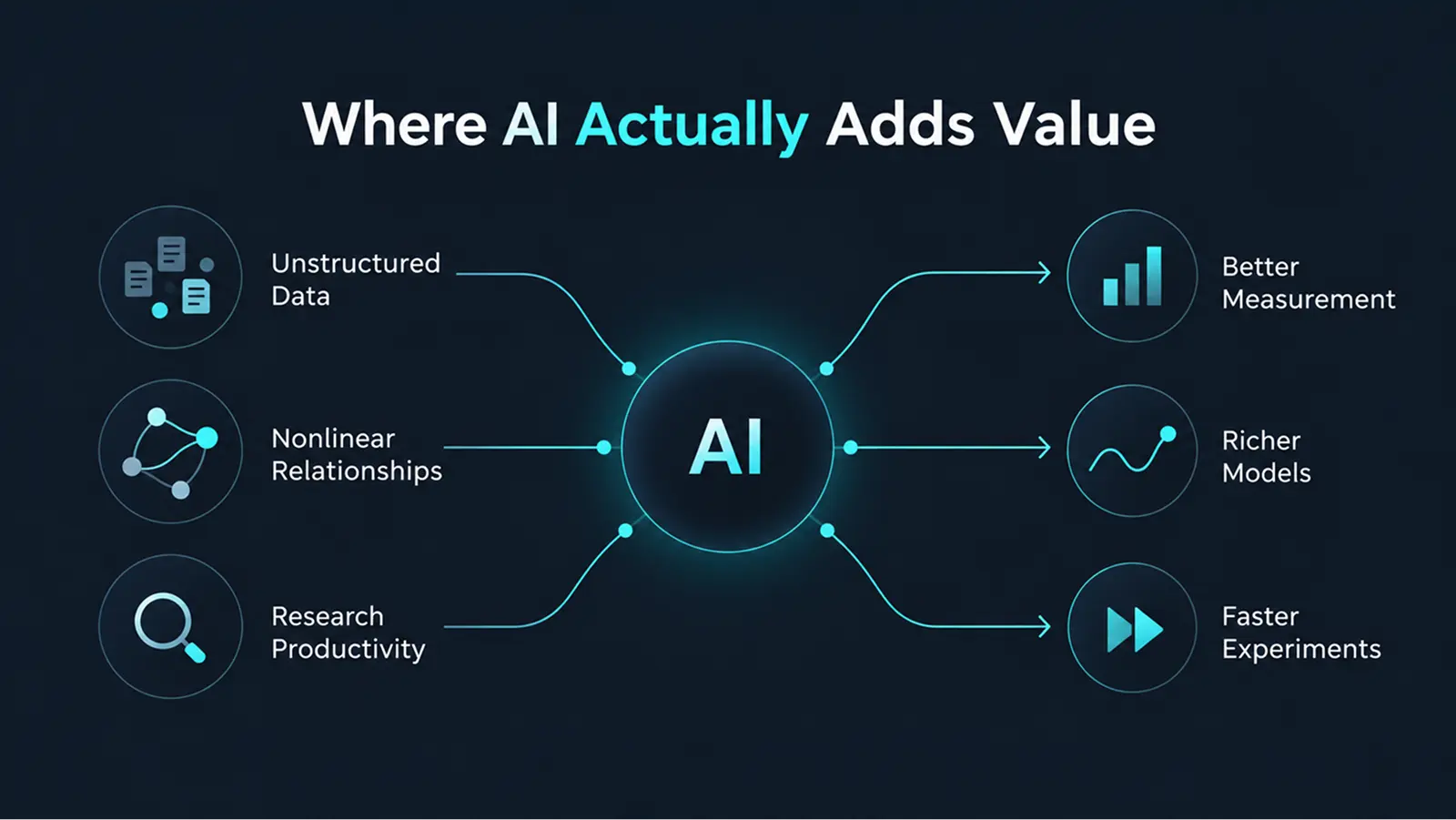
The strongest use cases for AI in quantitative research are more practical than the popular idea of an autonomous system that predicts markets from end to end. Its value is clearer in three areas: turning hard-to-use information into measurable data, capturing relationships that simpler models may miss, and making the research process itself more efficient.
1. Turning unstructured information into measurable data
Quantitative models need structured inputs, but much of the useful information in the world does not arrive in a clean table. It comes in the form of news, regulatory filings, earnings-call transcripts, images, irregular records, and datasets built under different conventions.
Natural-language processing can help organize large collections of documents, identify entities and topics, compare how language changes over time, and convert text into consistent numerical representations. Instead of reading a small sample manually, a researcher can measure the same feature across thousands of documents using a repeatable process.
In the corporate-announcement example, the goal is not to turn text directly into a buy or sell instruction. A more useful outcome might be a measure of which topics were discussed, how the wording changed from previous announcements, or how certain passages relate to known companies or events. Those measurements can then be studied alongside market and fundamental data.
The same idea applies to data engineering. ML tools can help with entity matching, anomaly detection, missing-data checks, and quality control. That creates value before prediction even starts: broader coverage, more consistent measurement, and less time spent turning raw information into research-ready inputs. A study can improve because the data are better, even if the final model remains simple.
2. Modelling nonlinear relationships
Classical statistical models often start with deliberately constrained assumptions. That is useful because simpler models are easier to interpret and harder to overfit. But those constraints can also prevent them from representing more complicated relationships.
A linear model might estimate how one variable relates to an outcome on average. A more flexible ML model can ask whether that relationship changes under different conditions. The same piece of information might behave differently in a highly liquid market than in a stressed one, or when expectations are already unusually high.
Tree-based models, neural networks, and other flexible methods can search across many such interactions without forcing researchers to specify every combination in advance. They can also represent thresholds, saturation effects, and changes in behaviour across different regimes.
That flexibility only matters if it survives testing. The point is not to use a more complex model because it is available. The point is to see whether it captures a plausible structure that a simpler specification cannot — and whether that improvement remains on unseen data.
3. Increasing research productivity
AI can also add value without predicting a market outcome at all.
Research teams spend a lot of time checking data, comparing experiments, searching technical documentation, reviewing code, reproducing previous work, investigating unexpected results, and monitoring changes in inputs and outputs.
AI-assisted tools can reduce the mechanical cost of that work. Language models can help researchers navigate codebases and documentation. Automated checks can flag inconsistent inputs or unusual distribution shifts. Experiment-tracking tools can make past results easier to find, compare, and reproduce.
The benefit is not that the researcher disappears. The benefit is that less time is spent on repetitive work and more time can go into designing experiments and interpreting results. Human review and reproducible workflows still matter, because automation can scale mistakes just as easily as good process.
Taken together, these three areas show where AI most clearly earns its place: it expands the information available to research, the relationships that can be represented, and the number of ideas a team can test carefully.
More Search Means More Ways to Be Wrong
Suppose one research idea produces a strong historical result. That may be interesting. Now suppose a team tests ten thousand variations — different inputs, assets, sampling rules, time windows, model settings, and evaluation dates — and reports only the best result. Suddenly, a very convincing pattern can appear even if there is no durable relationship underneath it.
AI increases the scale of that search. That can lead to real discoveries, but it also creates more opportunities to find false positives.
Three problems matter here. Overfitting happens when a model learns details of the historical sample that do not generalize. Data leakage happens when information enters the experiment even though it would not have been available at the time of the simulated decision. Multiple testing means that when enough alternatives are tried, some will look successful purely by chance.
These are not edge cases. Campbell Harvey, Yan Liu, and Heqing Zhu argue that the huge number of factors tested in financial research requires a much higher threshold for statistical evidence than a conventional single test. A large replication study also found that many published market anomalies did not survive standardized replication procedures.
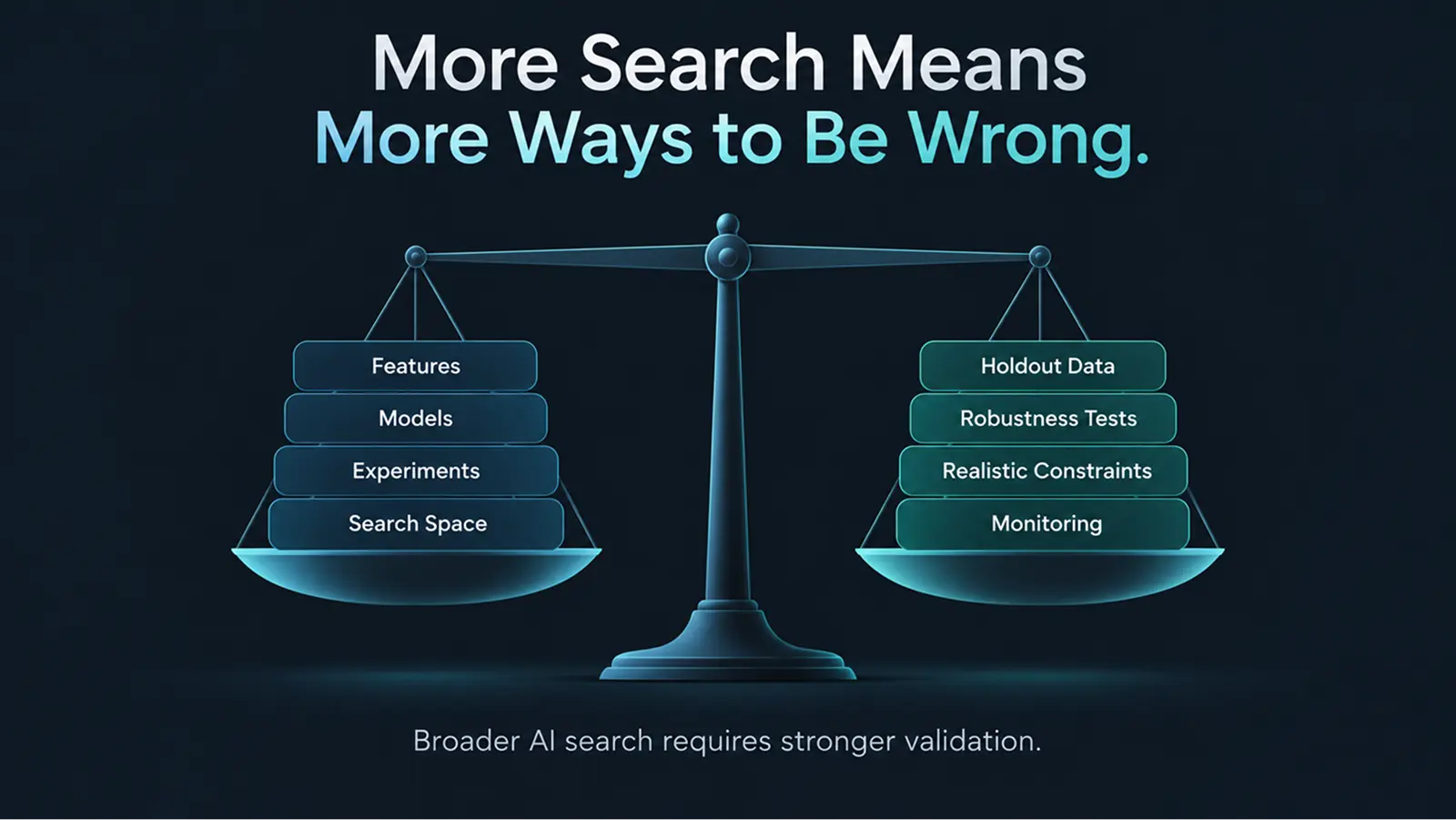
That is why validation is not something added at the end. It is part of the research process itself. A robust workflow keeps some data untouched, respects chronological order, tracks how many alternatives were explored, tests sensitivity to reasonable assumptions, and checks whether results hold across different periods or relevant universes. If a model could affect implementation, costs and operational constraints matter too. And once deployed, both the model and its inputs need ongoing monitoring.
The principle is simple: the more powerful the search becomes, the stronger the validation has to be.
Complexity Must Earn Its Place
Simple models remain useful for a reason. They are easier to understand, reproduce, debug, and monitor. They also provide a strong baseline. If a more flexible model cannot show a stable improvement on genuinely unseen data, then its extra complexity has not created much research value.
The right model depends on the problem. Large datasets and meaningful nonlinear structure may justify more flexibility. Limited data, unstable relationships, or a strong need for transparency may favour a constrained method instead.
So the practical standard is not “simple models are always better,” and it is not “AI will replace classical methods.” Complexity earns its place when repeatable evidence shows that it is doing useful work.
The Model Is Only One Component
Reliable quantitative research depends on much more than the model. It also depends on data provenance, research design, software engineering, reproducible experiments, validation, operational constraints, and monitoring. A weakness in any one of those areas can wipe out a small improvement in model accuracy.
Human expertise remains central, but not because people have some mysterious intuition that machines can never match. The role is more practical. Researchers decide what the objective is, spot implausible assumptions, judge whether the evidence is strong enough, investigate failures, and connect statistical results to how markets actually work. They also decide when a model should not be used.
Production ML systems create engineering problems of their own. Upstream data can change. Dependencies accumulate. A model can keep running while becoming less relevant to the environment it was built for. That is why testing and monitoring are part of model quality, not separate concerns.
Modern machine learning works best alongside established quantitative methods and solid engineering. AI can extend the reach of the researcher, but the surrounding system determines whether that extra reach produces knowledge or simply more output.
Better Research, Not Automatic Answers
AI creates real value in quantitative research when it makes hard-to-use information measurable, captures useful structure that simpler specifications miss, or makes the research process faster and more consistent.
The same capabilities also make it easier to discover patterns that are complex, persuasive, and wrong. That is why AI should raise the standard of evidence, not lower it.
The most valuable systems may not be the ones making the boldest predictions. They may be the ones that help researchers ask better questions, examine more evidence, and reject weak conclusions earlier. In an environment defined by uncertainty, that is already a meaningful advantage.
Sources
-
Shihao Gu, Bryan Kelly, and Dacheng Xiu, “Empirical Asset Pricing via Machine Learning,” The Review of Financial Studies, 2020.
https://doi.org/10.1093/rfs/hhaa009 -
Campbell R. Harvey, Yan Liu, and Heqing Zhu, “… and the Cross-Section of Expected Returns,” The Review of Financial Studies, 2016.
https://doi.org/10.1093/rfs/hhv059 -
Kewei Hou, Chen Xue, and Lu Zhang, “Replicating Anomalies,” The Review of Financial Studies, 2020.
https://doi.org/10.1093/rfs/hhy131